Using Environment Variables in Functions
In Hyac, you can dynamically read and set the current application's environment variables through the stable ctx.cloud.env() facade. This is useful for managing configurations, secrets, or other runtime data. Legacy entries ctx.env / context.env remain compatible.
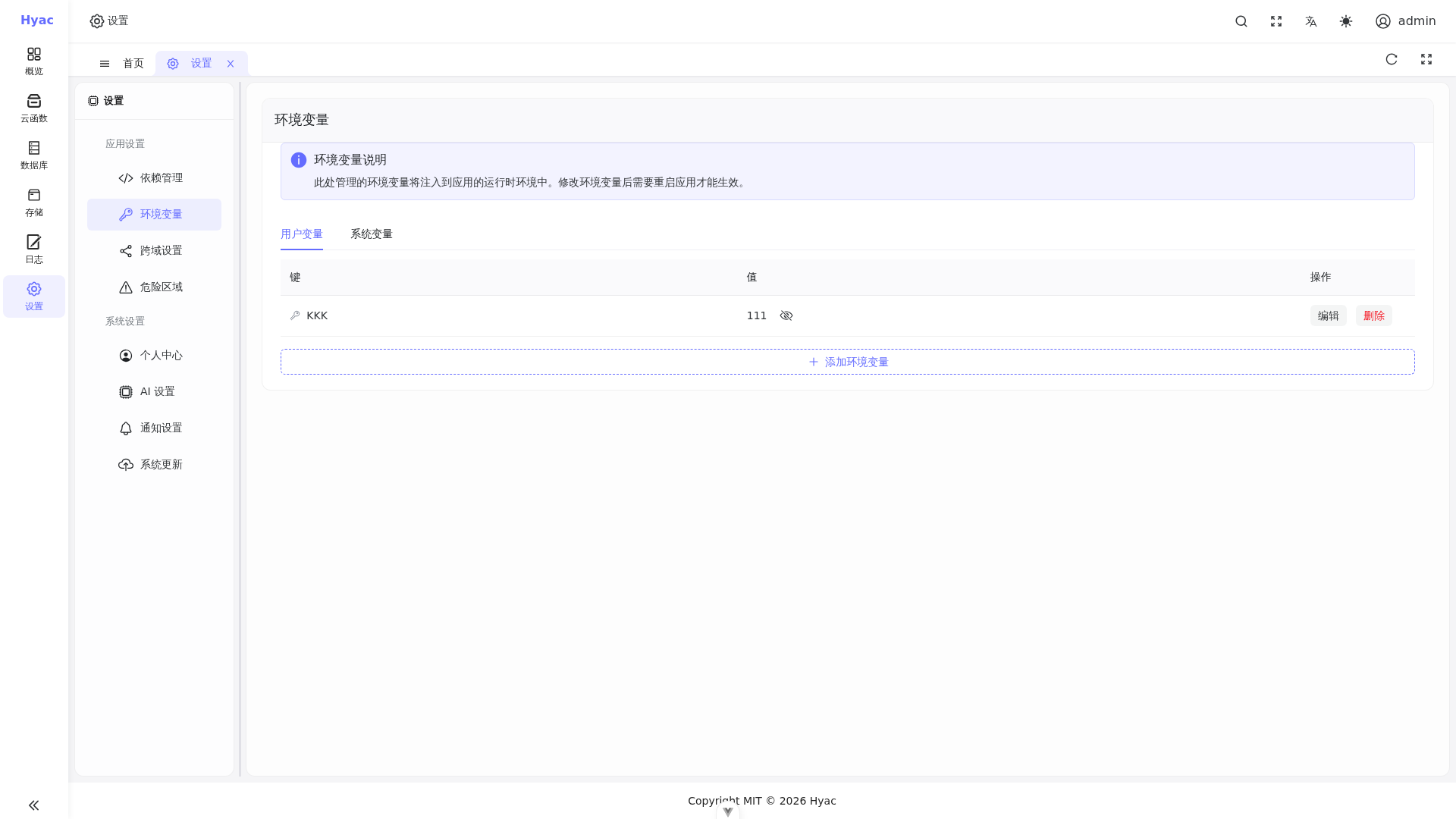
Use "Settings / Environment Variables" to manage application-level environment variables. The runtime watches environment changes and updates the process environment dynamically; restarting the application runtime is not required.
Calling await ctx.cloud.env().set(...) from code persists the value and immediately updates os.environ in the current runtime process. When environment variables are changed from the console, the runtime environment watcher receives MongoDB Change Stream events and refreshes os.environ dynamically.
1. Getting an Environment Variable
Use ctx.cloud.env().get("VARIABLE_NAME") to retrieve the value of an environment variable.
async def handler(ctx):
    """
    A function demonstrating how to get an environment variable.
    """
    env = ctx.cloud.env()
    # Get the environment variable named 'API_KEY'
    api_key = env.get("API_KEY")

    if not api_key:
        return {"error": "API_KEY not configured."}

    return {"message": f"Successfully retrieved API_KEY: {api_key[:4]}****"}
2. Setting an Environment Variable
Use await ctx.cloud.env().set("VARIABLE_NAME", "VALUE") to set or update an environment variable. This is an asynchronous operation.
Important: Environment variables set this way are persistent. They override any variable of the same name set in the admin dashboard and are immediately readable in the current runtime.
async def handler(ctx):
    """
    A function demonstrating how to set an environment variable.
    """
    new_api_key = "a-new-secret-key-generated-at-runtime"
    env = ctx.cloud.env()

    # Set or update the environment variable named 'API_KEY'
    await env.set("API_KEY", new_api_key)

    return {"message": "API_KEY has been updated successfully."}
By combining the get and set methods, you can implement dynamic configuration management, state persistence, and other advanced features without worrying about service interruptions due to configuration changes.